Evangelistic Bible Studies

In a location such as a freshman dorm it’s often advantageous to have an open Bible study—one that attended by both believers and non-believers.

An  “open” Bible study becomes a place to gather the spiritually interested or “seeking.” It’s something you can broadly publicize to the entire dorm and it becomes a safe place where believers can invite their non-Christian friends.

The challenge for such a group is what content to study and discuss. A typical Bible study will not be very fruitful with a mixed audience because much of the discussion is predicated on a personal faith in God, Jesus, and the Scripture.

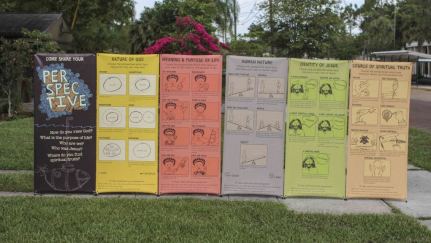
Which is why the Cru.comm Bible study material includes two “Exploration” studies. One series focuses on Paranormal subject matter (ghosts, angels, dreams, etc.) while the other explores what is referred to as the Seven Deadly Sins. Each study comes with its own poster making it easy to publicize and the content is specifically designed for a mixed audience believers and unbelievers.

Each week’s study builds on the previous week, and appropriately threads in biblical content. In the final week of the study the conversation ultimately leads to a thoughtful explanation and discussion of the gospel message, for whatever the issue, the ultimate answer is always found in Christ.

PARANORMAL

As the Apostle Paul comes into Athens (Acts 17), he actually compliments them on their religious fervency, though they believed in pagan idolatry. Using common spiritual examples, and working within their framework of belief, Paul is able to point the Athenians toward God. This is what we are attempting to do: to tap into current beliefs concerning the paranormal (ghosts, the afterlife, demons, clairvoyance, dreams, etc,) and turn the conversation in the right direction, toward Christ.

While certain topics within this evangelistic series do not pose a contradiction to a Christian worldview, some topics do. Christians for example do not believe in ghosts for “we are apportioned to die once and after that to face judgment” (Hebrews 9:27). But like Paul, we don’t want to walk into the secular marketplace of ideas and simply begin criticizing. Rather, in a nonthreatening way we want to enter into the dialogue, and see if we can turn the conversation to God.

People are interested in the supernatural, the challenge is to direct that interest and curiosity in a redemptive direction.

SEVEN

This is a seven-week series focused on the Seven Deadly Sins. The Seven Deadly Sins is the list of wicked human passions, first refined by Pope Gregory in the 6th century. It was heavily taught in the Middle Ages and by Dante in his work, The Divine Comedy. This epic poem had three parts: Inferno, Purgatorio, and Paradiso, which are about Hell, Purgatory, and Heaven/Paradise, respectively. They were called “Deadly Sins,” because of their fatal effect on spiritual health. In “Purgatorio,” Dante places each of the seven sins on a level, with the higher levels closer to Paradise and the lower ones closer to Hell.

There is no biblical support for the idea of “purgatory,” where sins are paid for by the sinner. Christ paid for all sin by His death on the cross. Those who receive His forgiveness have life; those that don’t do not have life. There is no in-between. Furthermore, the idea of a special list of “Deadly Sins” does not appear in the Bible. Some sins clearly have more devastating effects on one’s life than others, but the Bible does not create such overly simplistic categories.

That said, it does provide an interesting premise for an evangelistic study, and though many of these ideas have no biblical support, the topics, and sins, are certainly worthy of study and reflection for Christians while for the non-Christians they provide a vehicle by which to ultimately understand the gospel.

Both series can be found within Cru.comm. Each study comes with a student and leaders guide as well as a poster for that study.

Evangelistic Bible Studies
0 votes, 0.00 avg. rating (0% score)

Comments are closed.